Introduction
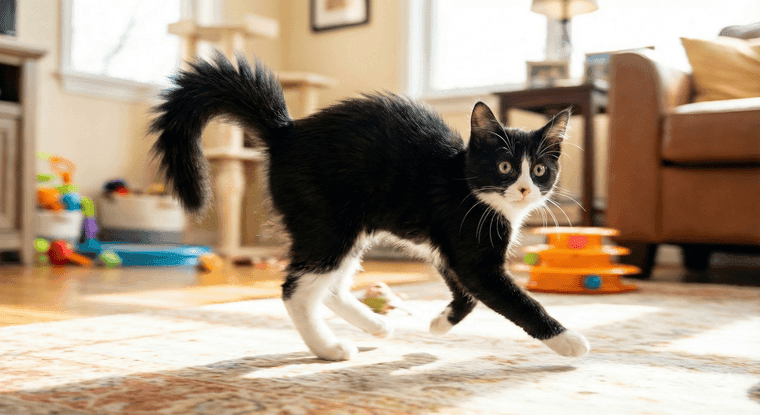
You’re watching your cat zoom around the living room at full speed, tail puffed up like a bottle brush, doing those ridiculous sideways hops and bouncing off furniture. They look like a Halloween decoration come to life. But here’s the thing, they’re clearly having the time of their life. No hissing, no hiding, just pure chaotic energy with what looks like a “scared” tail.
If you’ve ever noticed your cat tail puffed up but not scared, you’re witnessing one of the most misunderstood aspects of feline body language. While a puffed tail is often associated with fear or aggression, it can also signal excitement, playfulness, and high arousal in positive contexts. Your cat isn’t always frightened when their tail looks like they’ve stuck their paw in an electrical socket, sometimes they’re just really, really excited.
In this article, we’ll explore the fascinating world of feline tail signals, help you understand cat excited body language, and teach you how to tell the difference between a scared puff and a playful puff. Let’s decode what your cat is really trying to tell you with that magnificent bottle-brush tail!
Understanding Cat Tail Anatomy and Function
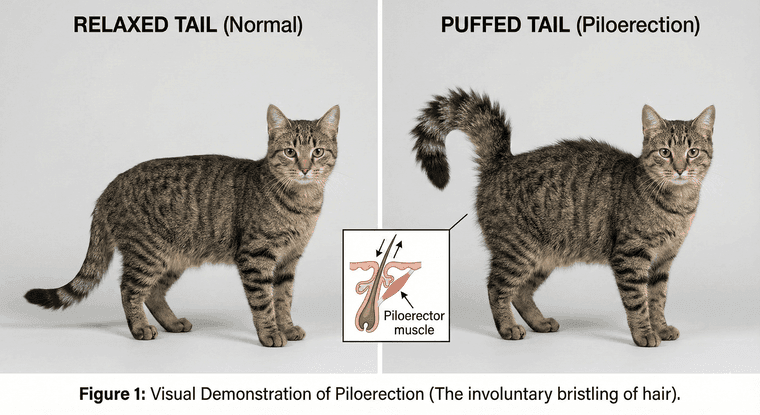
Before we dive into the different meanings behind a puffed tail, let’s talk about what’s actually happening when your cat’s tail transforms from sleek to supersized.
How the Tail Puffing Mechanism Works
The technical term for a puffed-up tail is piloerection, literally meaning “hair standing on end.” This happens when tiny muscles called arrector pili muscles contract at the base of each hair follicle, causing the hairs to stand straight up.
This is an involuntary response, much like goosebumps in humans. Your cat doesn’t consciously decide to puff their tail; it’s an automatic reaction to certain emotional or physical states. The response is controlled by the sympathetic nervous system, which kicks in during moments of high arousal, whether that’s fear, excitement, surprise, or intense play.
The evolutionary purpose of piloerection is to make the cat appear larger and more intimidating to potential threats. In the wild, looking bigger could mean the difference between scaring off a predator or becoming dinner. But in your cozy home, this same mechanism can trigger during a very enthusiastic play session or when your cat gets the zoomies.
The Tail as a Communication Tool
A cat’s tail is one of their most expressive body parts. It’s like a mood ring, constantly broadcasting how they’re feeling. But here’s the catch, you can’t interpret feline tail signals in isolation. A puffed tail combined with other body language cues tells the complete story.
Think of it like human communication. If someone raises their voice, are they angry? Excited? Scared? You’d need to look at their facial expression, body posture, and the context to really know. The same goes for cats. That puffed tail needs to be read alongside ears, whiskers, pupils, vocalizations, and overall body posture to understand what your cat is truly expressing.
Beyond Fear: The Emotional Spectrum
Here’s what many cat parents don’t realize: piloerection is triggered by arousal, and arousal isn’t inherently negative. Arousal simply means a heightened state of alertness and energy. This can come from fear, yes, but also from:
- Intense excitement
- Playful energy
- Surprise or startle (before fear sets in)
- Predatory focus
- Sexual arousal (in intact cats)
- Overstimulation during positive interactions
Understanding this distinction is key to recognizing when your cat tail puffed up but not scared is simply a cat having a great time.
The Main Reasons for Cat Tail Puffed Up But Not Scared
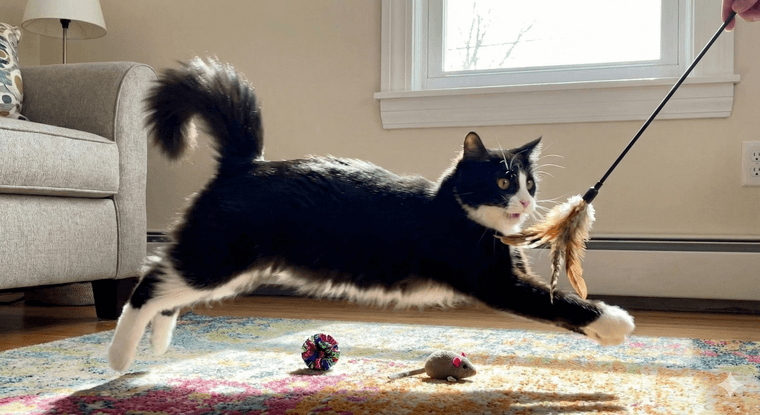
Let’s explore the most common scenarios where you’ll see that impressive puffed tail without any actual fear involved.
1. High Arousal During Play (The “Halloween Cat” Play Mode)
This is probably the most common reason for a puffed tail in a non-scared context. When cats play intensely, especially kittens and young cats, they can get so worked up that their entire body goes into high-arousal mode. The adrenaline pumps, the heart rate increases, and boom, instant bottle-brush tail.
You’ll often see this during the legendary “zoomies” when your cat suddenly tears through the house like they’re being chased by invisible demons. They’ll run, leap, bounce off walls, and their tail will be fully puffed the entire time. This is pure playful energy, not fear.
Kittens are particularly prone to this “Halloween cat” stance during play. They’ll arch their back, puff their tail, and do those adorable sideways hops when they’re feeling frisky. It looks dramatic, but it’s all in good fun, they’re practicing hunting and fighting skills in a safe, playful context.
2. Overstimulation and Excitement
Sometimes cats get so excited that they almost don’t know what to do with themselves. This intense excitement can trigger the same physiological response as fear, hence the puffed tail, even though the emotion is completely different.
This might happen when:
- You’re about to give them their favorite treat
- You pull out the most exciting toy
- Another pet in the house initiates play
- They’re watching birds through the window with intense focus
- They hear the can opener or treat bag rustling
The key difference between excited overstimulation and negative overstimulation is what happens next. An excited cat will engage with the stimulus (approach the toy, run toward you, etc.), while an overwhelmed cat will try to escape or show defensive behaviors.
3. Hunting Mode and Predatory Play
When cats are locked into hunting mode, whether stalking a toy mouse or preparing to ambush your ankles, their bodies prepare for action. This predatory arousal can cause tail puffing, especially right before the pounce.
You’ll often see this when your cat is:
- Stalking a feather wand or laser pointer
- Watching prey (real or toy) with intense focus
- About to ambush another pet in play
- Hunting a bug that dared to enter their territory
In these moments, that puffed tail is part of the “hunt excitement.” The cat isn’t scared, they’re thrilled. Their pupils will be dilated, but their body will be moving forward toward the “prey,” not retreating. This is cat excited body language at its finest.
4. Surprise and Startle (Without Actual Fear)
Have you ever jumped when someone surprised you, even though you weren’t actually scared once you realized what happened? Cats experience the same thing. A sudden unexpected event can trigger an instant tail puff before the cat’s brain has time to assess whether there’s actual danger.
Common startle scenarios include:
- Something falling or making a sudden noise
- Another cat jumping out from behind furniture
- You entering a room unexpectedly
- A toy activating suddenly
The difference between a scared puff and a startled puff is the recovery time. A truly frightened cat will maintain that puffed tail and defensive posture. A merely startled cat will puff up, quickly realize there’s no threat, and either relax or transition into playful curiosity, often within seconds.
5. Social Play with Other Cats
In multi-cat households, you’ll often see cats playing together with puffed tails. This is completely normal! When cats engage in rough-and-tumble play, wrestling, chasing, and mock fighting, both cats might sport impressive bottle-brush tails.
The key indicators that this is play, not aggression:
- Both cats keep coming back for more (no one is trying to escape)
- They take turns being the “chaser” and the “chased”
- No real hissing, screaming, or intense vocalizations
- Body language remains loose and bouncy, not stiff and defensive
- They pause periodically and re-engage voluntarily
This is actually how cats exercise, bond, and practice important survival skills. The puffed tails just show how into the game they are!
6. Excitement About Food or Treats
Some cats get so excited about mealtime that they work themselves into a frenzy, complete with puffed tail. This is especially common if you have a particularly food-motivated cat or if you’re about to give them something extra special.
You might notice this when:
- You’re preparing their meals
- Opening a can of tuna or their favorite wet food
- Breaking out special treats
- They know dinner time is approaching
Often, this excitement manifests in zoomies right before or after eating (the mysterious pre-meal or post-meal zoom is a real phenomenon!), and that racing around can come with a fully puffed tail. It’s pure excitement, not fear.
7. Territorial Display (Confident, Not Fearful)
Here’s an interesting one: sometimes a cat will puff their tail as a confident assertion of territory. This is different from the fearful defensive puff. A confident cat saying “this is MY space” has a very different overall body posture than a scared cat.
The confident territorial cat with a puffed tail will:
- Stand tall rather than crouching
- Move forward rather than backward
- Have forward-facing ears (alert, not flattened)
- Make direct eye contact
- Vocalize with assertive meows or growls (not panicked)
This is your cat essentially saying, “I’m big, I’m here, and this is mine.” It’s not fear, it’s confidence, even if it might be combined with some irritation if another cat is encroaching on their space.
8. Sexual Arousal (Intact Cats)
If your cat isn’t spayed or neutered, sexual arousal can cause tail puffing along with other interesting behaviors. Female cats in heat and male cats responding to females both display elevated arousal that can manifest in puffed tails.
This is accompanied by specific vocalizations (yowling), particular postures (females presenting, males calling), and restless behavior. This is one of many reasons vets recommend spaying and neutering, it eliminates these hormonally-driven behaviors that can be stressful for both cats and their humans.
How to Tell the Difference: Scared vs. Excited vs. Playful
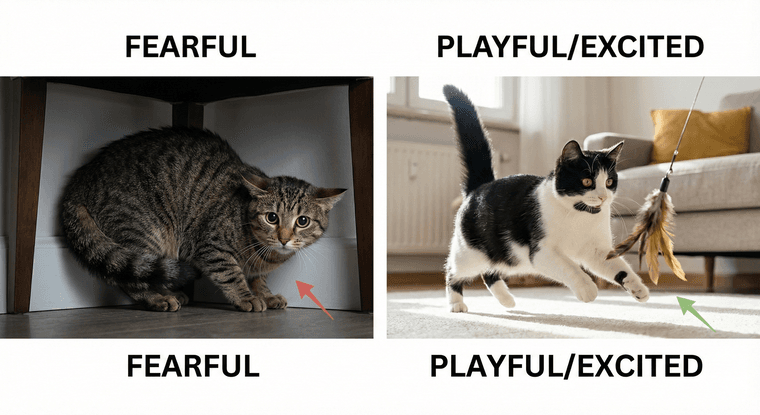
So you’ve got a cat with a puffed tail. How do you know what they’re actually feeling? The answer lies in reading the complete picture of their body language.
Signs of a Scared Cat with Puffed Tail
When a cat is genuinely frightened, the puffed tail comes with a whole constellation of fearful signals:
- Ears: Flattened completely back against the head
- Body: Crouched low to the ground OR arched high with stiff legs (the classic “Halloween cat” arch)
- Movement: Frozen in place, backing away, or running away
- Vocalizations: Hissing, growling, spitting, or yowling
- Eyes: Pupils fully dilated (completely black)
- Posture: Turned sideways to appear larger, or backing into a corner
- Overall demeanor: Tense, rigid, trying to escape or hide
A scared cat wants to appear bigger to the threat OR make themselves smaller to hide. They’re in full defense or flight mode. There’s no playfulness or looseness in their movements, everything is tight, tense, and focused on the perceived danger.
Signs of an Excited/Playful Cat with Puffed Tail
Now contrast that with cat excited body language when they’re playful or positively aroused:
- Ears: Forward-facing or rotating around (alert and engaged, not fearful)
- Body: Loose, fluid movements with bouncy energy
- Movement: Approaching, running, jumping, doing sideways hops
- Vocalizations: Chirps, trills, playful meows, or silence
- Eyes: Pupils moderately to fully dilated (aroused but engaged)
- Posture: Moving forward, play bows, wiggling rear end before pouncing
- Overall demeanor: Energetic, engaging, coming back for more
The big tell? Direction of movement. Excited cats move TOWARD things (toys, you, other cats, the source of excitement). Scared cats move AWAY from threats.
The “In-Between” State: Overstimulated
There’s also a middle ground where a cat becomes overstimulated during play or petting. Their tail might puff up as they transition from “this is fun!” to “this is too much!” This isn’t quite fear, but it’s a warning sign that arousal levels are getting too high.
Warning signs of overstimulation:
- Tail puffing and starting to thrash
- Skin rippling along their back
- Ears starting to rotate backward
- Sudden stillness or fixation
- Pupils becoming fully dilated
- Whiskers pressed flat against face
This is your cue to give your cat a break. Stop the play session or petting, give them space, and let them calm down. Pushing past this point can result in a bite or scratch, not because your cat is mean, but because they’re overwhelmed and need to discharge that excess energy somehow.
Common Scenarios Where Cat Tail Puffed Up But Not Scared
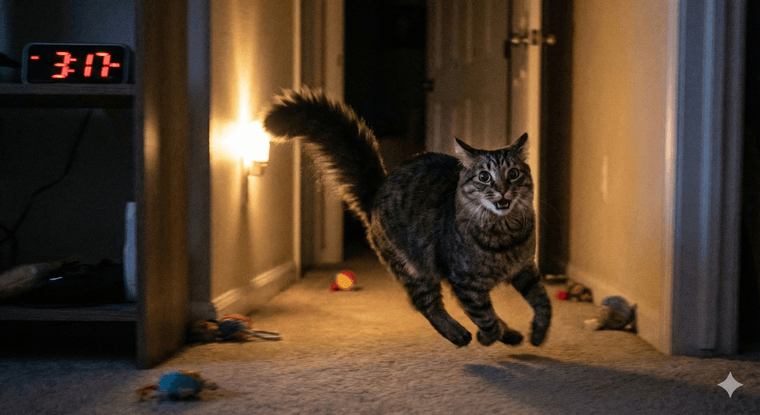
Let’s look at some specific everyday situations where you’re likely to see that impressive puffed tail without any fear involved.
The Midnight Zoomies
Ah yes, the legendary 2 AM sprint through the house. Many cats experience sudden bursts of energy, often at night, where they race around like maniacs. This often comes with a fully puffed tail, wild eyes, and acrobatic leaps off furniture.
This is called a “frenetic random activity period” (yes, that’s the actual term), and it’s completely normal. It’s how cats release pent-up energy, especially if they haven’t had enough physical activity during the day. The puffed tail is just part of the high-arousal excitement of the moment.
Post-Litter Box Zoomies
This is one of my favorite cat mysteries: why do so many cats zoom around with puffed tails right after using the litter box? Theories include:
- Relief and release of nervous energy
- Instinct to quickly escape the area (in the wild, waste attracts predators)
- Vagus nerve stimulation during elimination
- Pure joy at feeling lighter
Whatever the reason, it’s incredibly common and usually comes with a spectacularly puffed tail. It’s not fear, just one of those weird cat things that make them so entertaining.
Interactive Play Sessions
During intense play with feather wands, laser pointers, or chase toys, many cats will sport puffed tails. This is especially true when they’re really locked into the “hunt” and the excitement builds to a peak.
This is actually a sign you’re doing playtime right! Your cat is so engaged and excited that their whole body is reacting. As long as the play doesn’t escalate into aggression and your cat seems to be having fun, that puffed tail is a badge of honor for your play session.
Playing with Other Household Cats
When multiple cats play together, you’ll often see mutual puffed tails, along with chasing, wrestling, and those adorable sideways hops. As long as both cats are willingly participating (coming back for more rather than trying to escape), this is healthy social play.
Cats use play to establish social bonds, practice hunting and fighting skills, and burn energy. The puffed tails are just part of the excitement.
Age and Personality Differences in Tail Puffing
Not all cats puff their tails with the same frequency or in the same situations. Age and individual personality play big roles.
Kittens and Young Cats
Kittens are basically tiny chaos agents, and their tail puffing reflects that. Young cats tend to have less impulse control and get excited more easily, so you’ll see puffed tails frequently during play. They’re also still learning to regulate their arousal levels, so they can go from zero to “Halloween cat” in seconds.
This is normal developmental behavior. As kittens mature into adults, most will develop better emotional regulation and their tail puffing will become more selective.
Adult Cats
Adult cats (roughly 1-10 years old) have more control over their responses. They still puff their tails, but usually in more specific circumstances. Individual personality becomes more apparent, some adult cats are just more excitable and puff frequently, while others rarely puff except in genuine fear situations.
Senior Cats
Older cats (11+ years) tend to be more sedate and less prone to the kind of wild play that causes puffed tails. If a senior cat suddenly starts puffing their tail frequently, it’s worth paying attention to, it could indicate they’re more easily startled due to declining senses, experiencing pain, or dealing with cognitive changes.
Breed and Individual Differences
Some cats are just more dramatic than others! High-energy breeds like Bengals, Abyssinians, and Siamese tend to be more expressive overall, which can include frequent tail puffing during play. Long-haired cats can also appear more dramatically puffed simply because they have more fur to fluff up.
At the end of the day, individual personality matters most. Some cats are chill and rarely puff except when genuinely scared. Others are sensitive and excitable, puffing at the slightest excitement. Getting to know your individual cat’s baseline is key to interpreting their feline tail signals accurately.
When Playful Tail Puffing Becomes Concerning
While a cat tail puffed up but not scared is usually nothing to worry about, there are times when you should pay closer attention.
Distinguishing Play from Aggression
Sometimes what starts as play can escalate into actual aggression. Warning signs include:
- One cat trying to escape or hide while the other pursues relentlessly
- Intense vocalizations (screaming, serious growling)
- Fur actually flying (beyond normal grooming tufts)
- Injuries occurring (scratches, bite wounds)
- One cat looking fearful while the other is aggressive
- Play never deescalating, staying at peak intensity
If you see these signs, separate the cats calmly and give them time to decompress before allowing interaction again.
Chronic Stress vs. Temporary Excitement
A cat whose tail is puffed frequently throughout the day, not just during active play, might be experiencing chronic stress or anxiety. Other signs of ongoing stress include:
- Hiding more than usual
- Changes in eating or litter box habits
- Over-grooming or under-grooming
- Aggression toward people or other pets
- Excessive vocalization
If your cat seems to be in a constant state of arousal with a frequently puffed tail, consult your vet to rule out medical issues and discuss possible environmental stressors.
Medical Issues
Occasionally, tail puffing can be associated with medical problems:
- Pain: A cat in pain might puff their tail as part of a defensive posture
- Neurological issues: Nerve problems can affect tail control
- Hyperthyroidism: Can cause hyperactivity and excessive arousal
- Cognitive dysfunction: In senior cats, can lead to confusion and anxiety
If the tail puffing is accompanied by other symptoms like lethargy, appetite changes, litter box issues, or behavioral changes, schedule a vet visit.
How to Respond to Your Cat’s Puffed Tail Signals
Understanding what your cat is communicating is only half the battle, knowing how to respond appropriately is the other half.
When Your Cat is Playfully Excited
If your cat is clearly in playful excitement mode with a puffed tail:
- Engage with appropriate toys: Use wand toys, balls, or mice rather than your hands
- Let them “hunt”: Allow your cat to stalk, chase, and “catch” the toy
- Match their energy: If they’re in high gear, provide high-energy play
- Create safe spaces: Make sure they have room to run and jump safely
- Join in the fun: This is bonding time! Enjoy watching your cat’s natural behaviors
Managing Overstimulation
If you notice your cat is getting TOO worked up (tail puffing plus signs of stress):
- End the play session calmly: Don’t make a big deal of it
- Give them space: Let them decompress on their own terms
- Provide a calm environment: Reduce noise and activity
- Learn your cat’s limits: Some cats can play for 20 minutes, others max out at 5
- Wind down gradually: End play sessions with slower, gentler movements
Creating Enrichment Opportunities
To channel that puffed-tail energy appropriately:
- Daily play sessions: 15-20 minutes, twice a day minimum
- Environmental enrichment: Cat trees, window perches, puzzle feeders
- Vertical space: Cats need to climb and survey their territory
- Rotating toys: Keep things fresh and interesting
- Safe outdoor access: If possible, catios or supervised outdoor time
Understanding Feline Tail Signals: A Quick Reference
To help you become fluent in cat tail language, here’s a quick guide to what different tail positions generally mean:
Tail Position and Meaning:
- Straight up (question mark curve at tip): Happy, confident, friendly
- Straight up and puffed: Excited, aroused, playful (in positive contexts)
- Low and puffed: Defensive fear or aggression
- Tucked between legs: Fearful, submissive, anxious
- Swishing side to side: Irritated, overstimulated, focused on prey
- Wrapped around body/you: Affectionate, content
- Horizontal and relaxed: Neutral, calm
- Tip twitching: Focused, mildly irritated, or hunting mode
- Thrashing violently: Very irritated, about to lash out
Remember, context and other body language cues are essential for accurate interpretation. These are general guidelines, not absolute rules.
Conclusion
Understanding that a cat tail puffed up but not scared is possible opens up a whole new dimension of cat communication. That impressive bottle-brush tail isn’t always a danger signal, it can be your cat’s way of showing they’re excited, playful, or deeply engaged in an activity they love. By learning to read cat excited body language and interpreting feline tail signals in context with other body language cues, you become fluent in your cat’s emotional language.
Whether it’s the midnight zoomies, an intense play session, or that mysterious post-litter box sprint, embrace these puffed-tail moments for what they often are: your cat expressing pure joy and excitement. Just remember to watch for the difference between happy arousal and overstimulation, and always give your cat the space to decompress when needed. That magnificent puffed tail is just one more reason why living with cats is never boring!
Also Read - How to Keep Cat Off Kitchen Counter at Night: Proven Methods That Work
Frequently Asked Questions
Is it normal for my cat’s tail to puff up during play?
Yes, completely normal! Playful excitement causes the same physiological arousal as fear, triggering piloerection. As long as your cat’s overall body language is playful (forward-moving, loose, bouncy) rather than fearful (crouching, backing away, hissing), a puffed tail during play is just a sign they’re really into it.
Why does my cat run around with a puffed tail after using the litter box?
This is incredibly common! Theories include a relief response, vagus nerve stimulation, instinct to quickly leave the area, or just pure energy release. It’s harmless and actually kind of adorable. As long as your cat isn’t showing signs of pain or discomfort during elimination, post-bathroom zoomies are nothing to worry about.
My cat’s tail puffs up when playing with my other cat, should I separate them?
Not necessarily. If both cats keep voluntarily returning to play, take turns chasing each other, and show playful body language (forward ears, approaching movements, no intense vocalizations), this is normal social play. Only separate if one cat is trying to escape, if there’s serious aggression, or if injuries occur.
How can I tell if my cat is playing or actually aggressive when their tail is puffed?
Look at the complete body language picture. Playful cats have forward or rotating ears, move toward rather than away from stimulation, use loose bouncy movements, and take breaks that they end voluntarily. Aggressive cats have flattened ears, tense rigid bodies, serious vocalizations (screaming, intense growling), and display stalking or attacking without playful breaks.
My kitten’s tail is always puffed, is something wrong?
Kittens are excitable and still learning to regulate their arousal, so frequent tail puffing during play is very normal. It’s part of developmental play behavior and usually decreases as they mature. However, if your kitten’s tail is puffed even during calm, quiet times, or if they show other signs of stress or illness, consult your vet.