Introduction
You wake up in the morning, walk into your kitchen, and there they are, paw prints across your freshly cleaned counters. Maybe you find a knocked-over item, or worse, discover your cat has been helping themselves to last night’s leftovers. You scrubbed those counters before bed! You thought the problem was solved when you successfully trained your cat to stay off during the day, but clearly, the nighttime is a different story. Your cat has figured out that when you’re asleep, the kitchen is their playground.
If you’re struggling to keep cat off kitchen counter at night, you’re dealing with one of the most frustrating cat training challenges. Nighttime counter surfing is uniquely difficult because you can’t supervise, correct, or redirect in real-time like you can during waking hours. Your cat knows this, they’re smart enough to wait until you’re asleep to indulge in their counter-climbing habit. Beyond the frustration, this behavior poses genuine hygiene concerns (litter box paws on food prep surfaces, anyone?) and safety risks for your cat.
The good news is that nighttime counter jumping is absolutely solvable with the right combination of deterrents, environmental management, and consistency. In this comprehensive guide, I’ll share proven methods that work even when you’re sound asleep, helping you wake up to clean, cat-free counters every morning. Let’s tackle this nighttime challenge together!
Why Cats Jump on Counters at Night
Understanding the motivation behind nighttime counter surfing is the first step in stopping it. Several factors make nighttime particularly appealing for this behavior.

Natural Nocturnal Behavior
Cats aren’t strictly nocturnal, but they are crepuscular, naturally most active during dawn and dusk. In the wild, these twilight hours are prime hunting time. Your domestic cat retains these instincts, which means:
- Higher energy levels at night: Your cat is biologically programmed for activity when you’re trying to sleep
- Hunting drive activation: Nighttime triggers their predatory instincts, making them more exploratory and adventurous
- Boredom during quiet hours: The house is silent, you’re unavailable for play, and they need something to do
- Natural curiosity peaks: With nothing else happening, investigating the kitchen becomes entertainment
This isn’t your cat being deliberately difficult, it’s their biology working against your training efforts.
Daytime Supervision vs. Nighttime Freedom
Here’s the thing: your cat is smart. Really smart. They’ve figured out that you catch them on counters during the day and redirect them, but at night? Free reign. They learn your schedule and test boundaries when unmonitored.
During the day:
- You see them jumping up and immediately correct
- You clap, say “no,” or remove them
- They receive immediate consequences for counter jumping
- They learn counters = correction when you’re around
At night:
- No supervision means no immediate consequences
- They can explore freely for hours
- Success reinforces the behavior
- They learn counters are fine when you’re asleep
This creates a split understanding: “Counters are off-limits when humans are awake, but fair game when they’re asleep.”
Food Residue and Smells
Cats have an extraordinary sense of smell, about 14 times stronger than humans. What you think of as a “clean” counter still carries scent signatures that are incredibly appealing to your cat:
- Lingering cooking smells from dinner preparation
- Microscopic food particles you can’t see
- Crumbs from meal prep
- Residue from food packaging
- Grease or oil traces
At night, when the house is quiet and other sensory input is minimal, these food smells become even more prominent and enticing. Your kitchen essentially calls to them like a siren song.
High Vantage Point Appeal
Cats are natural climbers who feel secure and confident when elevated. Counters offer:
- Territory surveillance from a high position
- Visual dominance over their environment
- A sense of safety (away from perceived ground-level threats)
- Access to windows for watching nocturnal outdoor activity
- Warm surfaces near appliances
The counter isn’t just a forbidden surface, it’s prime real estate from your cat’s perspective.
The Problems with Nighttime Counter Surfing
Before diving into solutions, let’s acknowledge why this behavior genuinely needs to stop.
Hygiene and Health Concerns
This is the big one. Your cat uses their litter box, then walks on the same surfaces where you prepare food. The hygiene implications are significant:
- Bacteria transfer: E. coli, salmonella, and other bacteria from litter boxes end up on food prep surfaces
- Parasite concerns: Toxoplasma gondii (causes toxoplasmosis) can be transmitted through cat feces
- Cross-contamination: Cat paws can spread bacteria to dishes, utensils, and food
- Hair everywhere: Cat fur in your kitchen is inevitable but doesn’t need to be on your counters
This isn’t just about “ew” factor, it’s a real food safety issue.
Safety Hazards for Cats
Counter access at night poses risks to your cat:
- Hot surfaces: Stoves or burners that haven’t fully cooled
- Sharp objects: Knives left on cutting boards
- Toxic foods: Chocolate, grapes, onions, or other dangerous foods left out
- Chemicals: Cleaning products or medications
- Falling injuries: Knocking themselves off while jumping
You can’t cat-proof perfectly before bed every night, which makes preventing access the safer option.
Reinforcement of Bad Behavior
Every successful nighttime counter visit reinforces the behavior, making it harder to break. Your cat learns:
- Persistence pays off
- Rules aren’t consistent
- They can outsmart your daytime training
- Nighttime = counter access
This undermines all your daytime training efforts and makes the overall problem worse.
Proven Methods to Keep Cat Off Kitchen Counter at Night
Now for the solutions. Most cat owners find that combining multiple methods yields the best results.
Method 1: Motion-Activated Deterrents
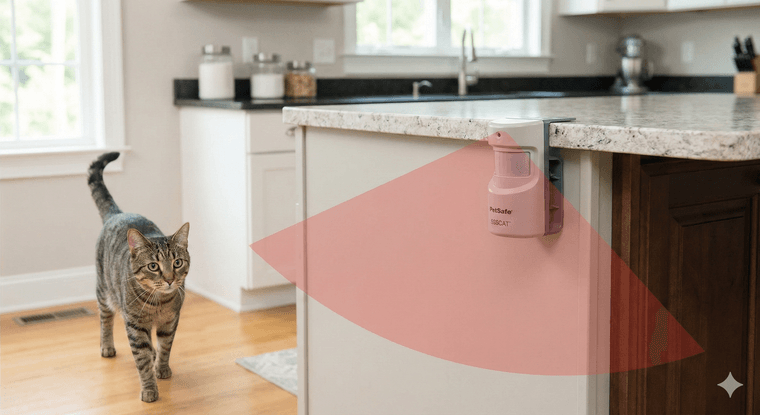
This is the gold standard for nighttime counter control because it works without your presence. Motion-activated devices detect your cat and trigger a deterrent response.
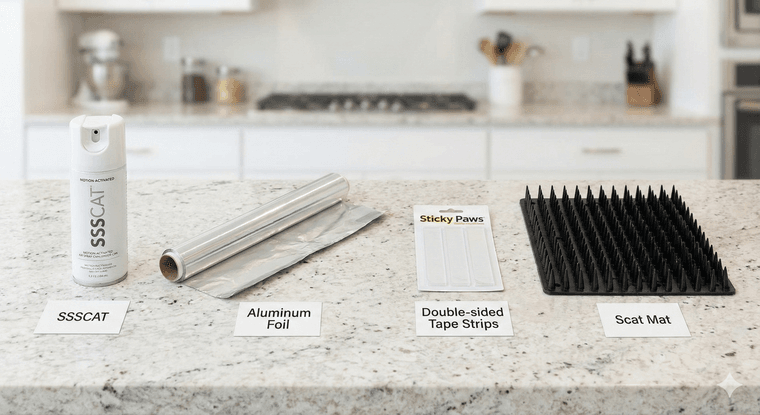
How they work: Motion sensors detect movement and release a burst of compressed air (harmless but startling). Products like PetSafe SSSCAT are specifically designed for this purpose.
Placement strategies:
- Position sensors where your cat typically jumps up
- Angle them to cover counter edges without false triggers from floor traffic
- Use multiple units for large counter areas
- Test sensitivity during setup
Effectiveness:
- Works 24/7 without your involvement
- Consistent response every single time
- Most cats develop counter aversion within 2-4 weeks
- Initial setup investment ($30-50 per unit) but long-term effective
Limitations:
- Refill cartridges needed periodically ($10-15)
- May startle initially (but that’s the point)
- Some cats eventually figure out sensor dead zones
- Battery replacement required
Method 2: Aluminum Foil and Texture Barriers
Cats hate the sound and feel of aluminum foil under their paws. This simple, cheap solution can be surprisingly effective.
Implementation:
- Cover entire counter surface with aluminum foil before bed
- Tape edges down so it doesn’t shift
- Leave in place nightly for 2-3 weeks
- Crinkly texture and sound deter most cats
Why it works: Cats dislike:
- The unexpected texture sensation
- The loud crinkling noise when stepped on
- The unstable, shifting surface
- The visual appearance (unfamiliar surface)
Pros and cons:
✓ Extremely cheap and accessible
✓ Non-toxic and harmless
✓ Easy to set up and remove
✗ Doesn’t work for all cats (some don’t mind it)
✗ Daily setup/removal is tedious
✗ Not aesthetically pleasing
Method 3: Double-Sided Tape Solutions
Products like Sticky Paws or generic double-sided tape create an unpleasant sticky sensation cats avoid.
Application:
- Apply strips of tape across counter surfaces
- Focus on jump-up points and frequently accessed areas
- Leave in place continuously for 3-4 weeks
- Remove gradually once behavior is broken
Success factors: Most cats hate sticky paws and will avoid surfaces that have trapped them once or twice. The sensation is unpleasant but not harmful, creating a negative association with counter jumping.
Practical considerations:
- Residue can be difficult to remove (test in inconspicuous spot first)
- May damage some counter finishes
- Needs replacement as it loses stickiness
- Works well in combination with other methods
Method 4: Physical Barriers
Sometimes the simplest solution is preventing access entirely.
Options:
- Close kitchen door: Most effective if you have a door
- Baby gates: Block kitchen entrance at night
- Barriers on counters: Stack lightweight items that fall when disturbed
When this works best:
- Open concept kitchens with doorways
- Temporary solution during training
- Households willing to sacrifice convenience
Limitations: Can’t work in truly open-concept homes or when kitchen access is needed at night (for you or other pets).
Method 5: Environmental Modifications
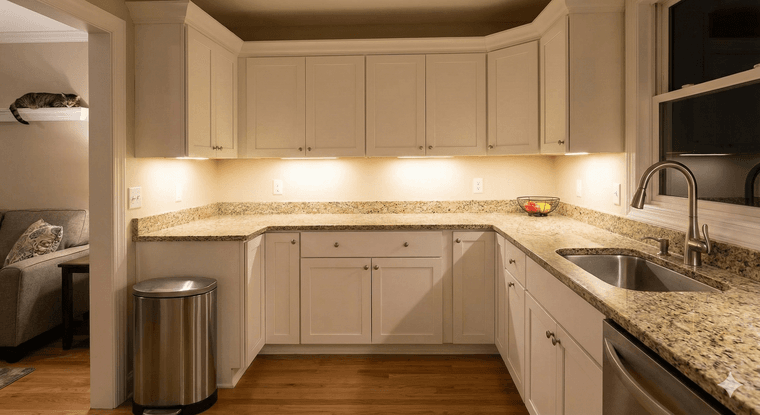
Making counters less appealing addresses the motivation rather than just the behavior.
Nighttime kitchen routine:
- Clean counters thoroughly: No food residue whatsoever
- Remove all items: Nothing interesting to investigate
- Secure trash: Lids that lock or take trash out nightly
- Put away dishes: No dirty plates with food smells
- Wipe with vinegar: Neutralizes food odors cats detect
When there’s nothing interesting on counters, cats are less motivated to jump up in the first place. This won’t completely solve the problem alone but significantly reduces temptation.
Method 6: Provide Alternative High Spaces
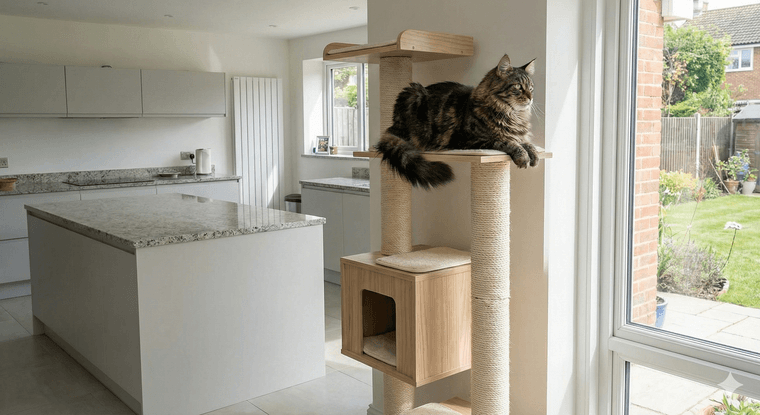
Cats need to climb and perch, it’s not optional for them. Providing acceptable alternatives redirects this natural instinct.
Solutions:
- Cat tree near kitchen: Tall structure they can climb instead
- Window perches: Mounted seats with outdoor views
- Wall-mounted shelves: Create vertical territory elsewhere
- Top-of-fridge access: If this is acceptable to you, make it the only allowed high spot
Make alternatives more appealing than counters by:
- Placing them near windows
- Adding cozy beds or pads
- Positioning near family activity
- Making counters less interesting simultaneously
Method 7: Increase Nighttime Activity and Enrichment
A tired cat is a well-behaved cat. Managing your cat’s energy before bedtime reduces nighttime shenanigans.
Pre-bedtime routine:
- Vigorous play session 30-60 minutes before bed: Use wand toys, laser pointers (end with catchable toy), or other interactive play
- Feed dinner after play: Mimics hunt-catch-kill-eat natural sequence
- Provide nighttime entertainment: Puzzle feeders, treat balls, or battery-operated toys
- Scheduled feeding: Last meal 1-2 hours before bed promotes sleepiness
When your cat’s physical and mental needs are met, they’re more likely to sleep through the night rather than entertaining themselves on your counters.
Method 8: Combination Approach
Here’s the truth: single methods rarely work perfectly alone. The most successful strategy for keeping your cat off kitchen counters at night combines multiple approaches:
Recommended combination:
- Motion-activated deterrent at primary jump points
- Environmental management (cleaned counters, no food)
- Alternative climbing options provided
- Pre-bedtime play and feeding routine
- Aluminum foil or tape as backup deterrent
Layer these methods to address all motivations: the deterrent creates immediate consequences, environmental changes remove motivation, alternatives redirect natural instincts, and energy management prevents boredom.
Step-by-Step Implementation Plan
Making multiple changes at once overwhelming? Here’s a phased approach to keep cat off kitchen counter at night.
Week 1: Preparation and Assessment
Day 1-3:
- Observe and note when/where your cat jumps up (check for paw prints in morning)
- Identify primary access points
- Purchase chosen deterrents
- Install motion sensors or prepare foil/tape
Day 4-7:
- Implement environmental management (clean counters thoroughly before bed)
- Set up deterrents before your bedtime
- Provide alternative climbing spaces
- Start pre-bedtime play routine
- Check counters each morning and adjust deterrent placement as needed
Week 2-3: Active Training
Continue all methods consistently:
- Maintain deterrents nightly
- Never skip environmental management
- Sustain play and feeding schedule
- Document any counter access (paw prints, disturbed items)
- Adjust strategies based on results
Week 4+: Reinforcement and Maintenance
By week 4, most cats show significant improvement:
- Continue successful methods
- Begin testing without some deterrents (one at a time)
- Maintain environmental management permanently
- Watch for backsliding and reintroduce deterrents if needed
Expected timeline: Most cats develop reliable nighttime counter avoidance within 4-6 weeks of consistent training.
What NOT to Do
Certain approaches are ineffective or counterproductive when trying to keep cat off kitchen counter at night.
Ineffective Punishment Methods
Don’t do these:
- ❌ Yelling at your cat in the morning for nighttime counter jumping (they don’t connect delayed punishment to past behavior)
- ❌ Physical punishment ever (damages trust, doesn’t work, may cause aggression)
- ❌ Spray bottles (you’re asleep, can’t use them when behavior happens)
- ❌ Shaking noise cans after the fact (must be immediate to be effective)
Punishment only works when it’s immediate, consistent, and directly connected to the behavior. Since you’re asleep, punishment-based training is impossible for nighttime behavior.
Inconsistent Application
Consistency killers:
- Allowing counter access sometimes but not others
- Only using deterrents on weeknights but not weekends
- One family member enforcing rules while others don’t
- Giving up after a few days
Cats learn through consistency. If rules change based on day of week or who’s home, they’ll remain confused and continue testing boundaries.
Dangerous Deterrents
Never use:
- Toxic substances (citrus oils at harmful concentrations, pepper, etc.)
- Overly aggressive shock mats (mild static mats designed for pets are okay; anything stronger is cruel)
- Mousetraps or anything that could physically harm your cat
- Unstable items that could fall and injure
Safety first, always. Deterrents should be unpleasant but never dangerous.
Troubleshooting Common Problems
What if the standard methods aren’t working? Here are solutions to common challenges.
Cat Ignores Deterrents
If your cat seems unfazed by aluminum foil, motion sensors, or tape:
Try this:
- Increase intensity (more motion sensors, complete foil coverage, stickier tape)
- Combine multiple deterrents simultaneously
- Switch to completely different deterrent type
- Address underlying needs better (more play, alternative climbing, environmental enrichment)
- Rule out medical issues causing behavior changes (increased hunger, cognitive problems in seniors)
Some cats are more determined or less sensitive to certain deterrents. Persistence and variety are key.
Works Temporarily, Then Fails
If your cat stops jumping on counters for a week or two then resumes:
Reasons and fixes:
- Habituation: Cat got used to deterrent → rotate to different method
- Found workaround: Cat discovered sensor dead zones → reposition or add more units
- Deterrent ran out: Tape lost stickiness, sensor ran out of spray → maintain and refresh regularly
- Motivation increased: New temptation introduced → improve environmental management
Maintenance is ongoing. Don’t completely remove deterrents until behavior is solid for 6-8 weeks.
Multi-Cat Household Challenges
When you have multiple cats:
- Different personalities: One cat may respond to foil while another doesn’t care
- Social learning: Cats may watch each other and learn counter jumping or avoidance
- Individual strategies: May need different deterrents for different cats
- Increased motivation: Competition for resources or territory
Use multiple deterrent types simultaneously to catch all personality types.
Success Stories and Realistic Expectations
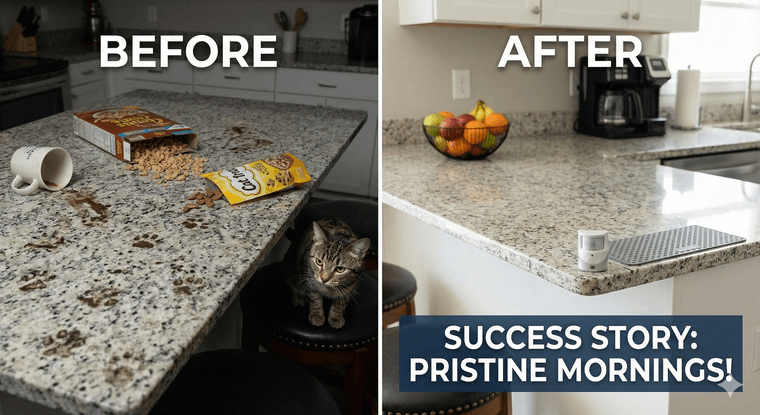
Real experiences from cat owners who successfully solved this problem:
Story 1: Motion sensor success “I spent $80 on three PetSafe SSSCAT units and positioned them at all three counter access points. My cat was startled the first few nights but by week 3, she stopped trying entirely. After 6 weeks, I removed one sensor as a test, she never went near that counter again. Worth every penny.”
Story 2: Aluminum foil method “I was skeptical about foil, but I committed to covering my entire counter every single night for a month. My cat HATED it. By week 3, he’d stop at the counter edge, extend a paw to test, encounter foil, and walk away. Now I only need to put foil out occasionally as a reminder.”
Story 3: Combination approach “Nothing worked alone, not foil, not tape, not even the motion sensor by itself. But when I combined the sensor with thoroughly cleaning counters, playing with my cat hard right before bed, and giving her a tall cat tree near the kitchen, the problem resolved within 5 weeks.”
Realistic timeline:
- Week 1-2: Experimentation, possibly continued counter jumping
- Week 3-4: Noticeable reduction in behavior
- Week 5-6: Consistent avoidance forming
- Week 8+: Habit broken, maintenance mode
Some cats are more stubborn and take 8-12 weeks. Perseverance is essential.
Conclusion
To successfully keep cat off kitchen counter at night requires addressing multiple factors: the lack of supervision, your cat’s natural nocturnal energy, the appeal of elevated surfaces, and the attractive smells in kitchens. The most effective solution combines deterrents that work while you sleep (motion-activated devices, aluminum foil, or tape), environmental management to remove temptation (thoroughly cleaned counters with no food residue), and meeting your cat’s needs through alternative climbing spaces and pre-bedtime play that burns excess energy. While daytime training focuses on active correction and redirection, nighttime success depends on creating an environment where counter jumping is both unappealing and unrewarding even without your supervision.
Most cat owners see significant improvement within 4-6 weeks when implementing these strategies consistently, though particularly determined cats may take up to 8-12 weeks. The key is patience, consistency across all household members, and refusing to give up when you encounter initial resistance. Yes, covering your counters with aluminum foil every night for a month is tedious, and motion sensors require an upfront investment, but the payoff, waking to clean, cat-free counters and maintaining proper kitchen hygiene, is absolutely worth the effort. Stick with it, adjust your approach as needed, and celebrate the small victories along the way!
Also Read - Cat Staring at Wall: When to Worry and When It's Normal Behavior
Frequently Asked Questions
How long does it take to train a cat to stay off counters at night?
Most cats improve within 4-6 weeks with consistent use of effective deterrents (like motion sensors, foil, or tape) and strict environmental management. Very stubborn cats may take 8-12 weeks. Absolute consistency is vital. While some cats may always require long-term deterrents, success is defined by regularly waking up to clean counters.
Will motion-activated deterrents scare my cat too much?
Motion-activated air spray devices like PetSafe SSSCAT use a harmless air burst to startle cats, creating a negative association with counter jumping without causing lasting fear. Cats quickly learn to avoid the area. If your cat shows extreme stress (hiding, refusing to enter the kitchen), use gentler deterrents or reduce the device’s sensitivity.
Can I train my cat to stay off counters at night but allow it during the day?
Trying to teach a cat time-based rules, like “no counters after 10 PM,” is extremely difficult and confusing for them. Cats learn best with consistent, simple rules. Most behaviorists recommend a blanket rule: counters are either always off-limits or always allowed. To satisfy your cat’s need for high perching, provide alternatives like cat trees or shelves.
What’s the most effective single method for nighttime counter jumping?
Motion-activated air spray deterrents (like PetSafe SSSCAT) are the most effective single method because they provide immediate, consistent consequences 24/7. However, complete success usually requires a combination approach: using motion deterrents alongside environmental management (cleaning counters) and meeting your cat’s needs (pre-bedtime play, alternative climbing spots). If you can only choose one method, motion sensors are best, but combining methods yields optimal results.
My cat only jumps on counters when I’m asleep. How do they know?
Cats are observant and quickly learn routines. Your cat has realized that counter jumping during the day results in immediate correction, but nighttime jumping goes unnoticed. They know you’re asleep by your door closing, lights out, quiet house, and lack of movement/sound. This isn’t manipulation; it’s intelligent adaptation, testing boundaries when unsupervised. Therefore, nighttime-specific solutions like motion sensors or aluminum foil are necessary to create consequences when you can’t.