
Introduction
You need to move your cat’s litter box. Maybe you’re renovating the bathroom, preparing for a new baby, or simply tired of having the litter box in a high-traffic area. Whatever the reason, you’re facing a dilemma: how do you relocate the box without triggering a series of unfortunate “accidents” around your home? You know your cat is particular about their bathroom habits, and the last thing you want is to come home to unpleasant surprises in corners, on carpets, or worse, on your bed.
The good news is that you absolutely can transition cat to new litter box location successfully without accidents, stress, or drama. The key lies in understanding why location matters so much to cats and following a gradual, strategic approach that works with your cat’s instincts rather than against them. Moving a litter box isn’t like rearranging furniture; to your cat, you’re relocating their private bathroom, and they need time to adjust to this significant change.
In this comprehensive guide, I’ll walk you through the proven step-by-step method for moving litter boxes smoothly, troubleshooting common problems, and ensuring long-term success. Whether you’re moving the box across the room or to a different floor, these strategies will help you make the transition as stress-free as possible for both you and your feline friend. Let’s get started!
Why Litter Box Location Matters to Cats
Before diving into the how-to, it’s crucial to understand why cats are so sensitive about where they do their business. This isn’t your cat being difficult; it’s biology and instinct at work.
Cats are Creatures of Habit
Cats thrive on routine and predictability. They map their territory mentally, creating a cognitive layout of their home that includes resource locations: where food is found, where water is located, where they sleep, and critically, where they eliminate. When you suddenly move the litter box, you’re disrupting this mental map. Your cat goes to the familiar location and finds… nothing. This confusion can lead to:
- Stress and anxiety about where to eliminate
- Accidents at the old location (they think the box should still be there)
- Searching behavior that might result in emergency elimination elsewhere
- General anxiety about whether their needs will continue to be met
Think about it from your cat’s perspective: imagine if someone moved your bathroom without telling you. You’d head to the usual spot and find it gone. Confusing and stressful, right? That’s exactly how your cat feels.
Security and Privacy Needs
Elimination is a vulnerable time for cats. In the wild, this is when predators might attack. Even though your pampered house cat doesn’t face actual predators, these instincts remain strong. Cats need their litter box location to feel:
- Safe: Away from startling noises or sudden movements
- Private: Not in high-traffic areas or exposed locations
- Secure: With multiple escape routes (cats hate feeling cornered)
- Quiet: Away from washing machines, furnaces, or other noisy appliances
A litter box in the middle of a busy hallway or right next to a loud dryer might technically be accessible, but it doesn’t feel safe to your cat. They may hold their elimination or find alternative, quieter locations—like behind your couch.
Scent and Familiarity
Cats have an incredibly keen sense of smell, and they use scent to navigate their world. When a litter box has been in one location for a while, that entire area carries the scent signature of “this is where I go to the bathroom.” Your cat can find this location even in the dark, guided by familiar smells.
When you abruptly move the box, you’re breaking this scent connection. Your cat may return to the old location because it still smells like their bathroom, even though the physical box is gone. This is why proper cleanup of the old location and gradual movement are so important.
Common Reasons for Moving Litter Boxes
Understanding why you need to move the box helps determine your approach. Common scenarios include:
- Home renovations: Bathroom remodeling or construction work
- New family members: Baby arriving, elderly relative moving in
- Moving to a new home: Complete relocation
- Better placement: Improving smell control or accessibility
- Multi-cat conflicts: Separating resources to reduce territorial tension
- Senior cat accessibility: Moving boxes to more accessible locations as cats age
- Aesthetic reasons: Let’s be honest—visible litter boxes aren’t attractive
Each situation may require slight modifications to the basic transition strategy, but the core principles remain the same.
Understanding the Risks of Abrupt Changes
Why can’t you just pick up the box and move it? Let’s look at what can go wrong.
Inappropriate Elimination
The most obvious risk is accidents outside the litter box. When cats can’t find their box or don’t like the new location, they’ll eliminate somewhere—and that somewhere might be your carpet, laundry pile, or favorite chair. Once a cat eliminates somewhere inappropriate:
- The scent remains (even after cleaning) and can attract repeat offenses
- A pattern of inappropriate elimination can develop
- The cat may begin associating the litter box with stress
- Multiple areas of your home can become “bathroom spots”
Breaking these patterns is much harder than preventing them in the first place.
Stress and Anxiety
Change is stressful for cats. An abrupt litter box relocation can trigger:
- General anxiety and behavioral changes
- Hiding or withdrawal
- Appetite changes
- Over-grooming or other stress behaviors
- Aggression or irritability
- Health issues (stress can trigger or worsen conditions like urinary problems)
Stress isn’t just unpleasant—it can have real health consequences for your cat.
Litter Box Aversion
In worst-case scenarios, traumatic experiences with litter box changes can lead to litter box aversion, where cats develop a psychological resistance to using litter boxes at all. This is incredibly difficult to reverse and may require professional behavioral intervention. Prevention through careful transition is always preferable.
Before You Start: Planning the Transition
Proper preparation sets you up for success. Here’s what to do before moving anything.
Choosing the New Location
Not all locations are created equal. The new spot should meet these criteria:
✓ Quiet and low-traffic: Not in the middle of hallways or busy rooms
✓ Accessible 24/7: Cats need access at all hours, even when doors are closed
✓ Away from food and water: Cats prefer separation between eating and elimination areas
✓ Multiple escape routes: Never corner a litter box where your cat could be trapped
✓ Adequate ventilation: Good airflow helps with odor and comfort
✓ Appropriate flooring: Easy to clean in case of accidents during transition
✓ Stable temperature: Not too hot (near heating vents) or too cold (unheated basement)
✓ Away from loud appliances: No washing machines, dryers, or furnaces nearby
For multi-cat households, ensure adequate space for multiple boxes with visual barriers between them.
Timing Considerations
Choose your timing wisely. Avoid starting the transition during:
- Other major household changes (moves, renovations, new pets)
- Holiday periods with guests and disruption
- When your cat is ill or recovering from illness
- Right before or after veterinary procedures
- Extreme weather that affects household routines
Start the transition when life is relatively calm and you have 3-4 weeks to dedicate to the process.
Assessing Your Cat’s Personality
Different cats adapt at different rates:
- Easy-going cats: May adapt in 2-3 weeks
- Anxious or sensitive cats: May need 4-6 weeks or longer
- Senior cats: Often need extra time and modifications
- Cats with previous litter box issues: Require especially gradual approach
- Multiple cats: Each may adapt differently; proceed at the pace of the slowest cat
Be honest about your cat’s temperament and adjust your timeline accordingly.
Preparing the New Space
Before introducing your cat to the new location:
- Clean the area thoroughly
- Ensure adequate lighting (cats need to see what they’re doing)
- Remove any items that might startle your cat
- Test the space by sitting there yourself—is it quiet? Private? Comfortable?
- Consider adding a pheromone diffuser nearby to create positive associations
The Gradual Transition Method: Step-by-Step
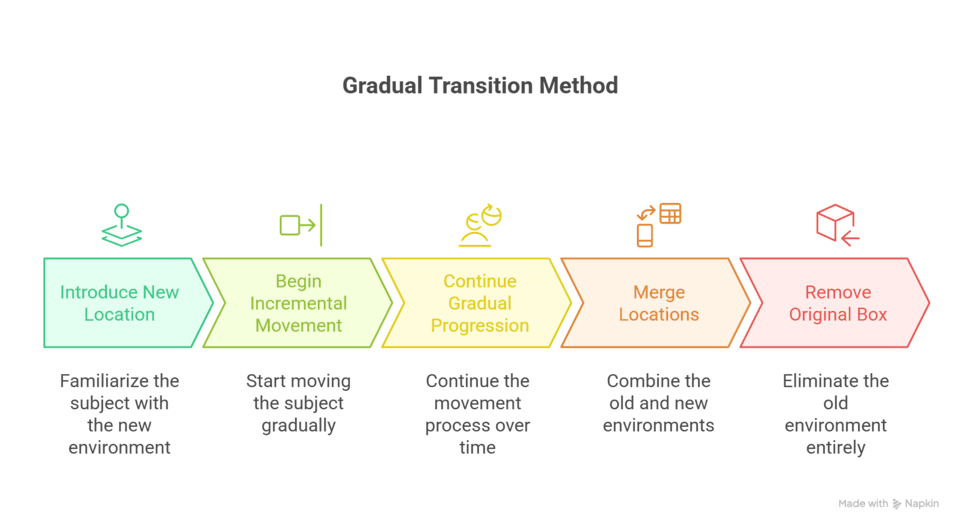
Here’s the proven approach to successfully transition cat to new litter box location without accidents. This method works for most cats and situations.
Step 1: Introduce the New Location (Days 1-3)
Start by adding, not moving. Place a second litter box at the new location while keeping the original box exactly where it is. This gives your cat options and introduces the new spot without removing the familiar one.
What to do:
- Set up identical box with same litter type at new location
- Keep original box in place
- Scoop both boxes daily
- Observe which box your cat uses (or if they use both)
- Don’t force interaction—let discovery happen naturally
What you’re watching for:
- Does your cat investigate the new box?
- Do they use it willingly?
- Any signs of stress or confusion?
Many cats will start using the new box immediately out of curiosity. Others might ignore it initially—both responses are normal.
Step 2: Begin Incremental Movement (Days 4-7)
Once your cat has discovered and ideally used the new box at least once, begin slowly moving the original box toward the new location. The key word here is slowly—we’re talking just a few feet per day.
Movement guidelines:
- Move the original box 2-3 feet closer to the new location each day
- Move in a direct path (don’t zigzag)
- Always move after your cat has used the box, not before
- Clean the old floor spot after each move
- Continue maintaining both boxes
Example: If the original box is in the bathroom and new location is in the laundry room 15 feet away, move the original box approximately 3 feet per day. This would take about 5 days to complete.
Important: If your cat seems confused or has an accident, you’re moving too fast. Back up to the previous location and slow down.
Step 3: Continue Gradual Progression (Week 2)
Keep the incremental movement going throughout the second week. By now, your cat should be comfortable with both boxes and following the original box as it migrates.
Mid-transition checkpoints:
- Is your cat using both boxes?
- Any accidents at the old locations along the path?
- Signs of stress (appetite changes, hiding, excessive grooming)?
- Is your cat following the moving box comfortably?
If everything is going smoothly, continue. If you notice problems, pause the movement for a few days at the current location before proceeding.
Step 4: Merge Locations (Week 3)
By week three, the original box should have traveled close to or into the same area as the second box. Now you have two boxes in essentially the same location—the intended new spot.
What to do:
- Continue maintaining both boxes meticulously
- Observe if your cat shows preference for one box over the other
- Ensure both boxes are clean and appealing
- Maintain this setup for at least a week
This redundancy is your insurance policy. If your cat hasn’t fully adapted, they still have options.
Step 5: Remove Original Box (Week 4+)
Only when your cat is reliably and consistently using the new location should you remove the original box. Even then, do it carefully:
Removal process:
- Remove the original box but keep it cleaned and available nearby (in a closet or garage)
- Watch closely for 2-3 days
- If any accidents occur, immediately return the original box
- If everything goes smoothly for 3-4 days, you can consider the transition complete
- Thoroughly clean the old location path with enzymatic cleaner
Don’t rush this step. It’s better to have two boxes permanently than to rush removal and trigger litter box problems.
Alternative: The Dual Box Method
Sometimes the gradual movement method isn’t practical (moving between floors, across long distances, or in homes with unusual layouts). In these cases, use the dual box method:
- Add new box at desired location
- Keep original box in place indefinitely
- Gradually make the new location more appealing and the old location less so (by scooping new box more frequently, using fresh litter there, etc.)
- Never remove the original box until the new one is used exclusively for several weeks
For many multi-cat households, keeping both boxes permanently is actually the best solution, as it follows the “n+1” rule (one box per cat plus one extra).
Special Situations and Modifications
Different scenarios require adapted approaches to transition cat to new litter box location.
Moving Between Floors
Moving a litter box upstairs or downstairs requires special consideration:
For senior cats or cats with mobility issues:
- Consider keeping boxes on both floors permanently
- Install ramps or steps if necessary
- Ensure your cat can physically navigate stairs comfortably
- Never assume an older cat will go up and down stairs for the litter box
For able-bodied adult cats:
- Use the gradual method, moving the box toward the stairs
- Place the box at the top or bottom of stairs for several days
- Then move to the final floor location
- Keep a second box on the original floor for at least 3-4 weeks
Multi-Cat Households
With multiple cats, you’re managing different personalities and adjustment speeds:
- Maintain enough boxes throughout transition (minimum n+1 rule)
- Watch each cat individually—don’t assume they’ll all adapt at the same rate
- Look for territorial disputes or blocking behavior at boxes
- Be prepared to keep multiple boxes in multiple locations permanently
- Monitor all cats for signs of stress or inappropriate elimination
The slowest-adapting cat sets your pace. Don’t remove boxes until every cat is comfortable.
Senior Cats
Older cats need extra consideration:
- Move very gradually (maybe only 1-2 feet per day)
- Consider cognitive dysfunction (cat dementia)—severely affected cats may not adapt well
- Ensure new location is easily accessible (no stairs, no jumping required)
- Use low-entry boxes if arthritis is a concern
- Keep nightlights along the path so senior cats can find boxes at night
- Expect the process to take 6-8 weeks rather than 3-4
For some senior cats, the kindest approach is adding a new box rather than relocating the old one.
Troubleshooting Common Problems
Even with careful planning, issues can arise. Here’s how to address them.
Cat Refuses to Use New Location
If your cat completely avoids the new box:
Check location problems:
- Is it too exposed or noisy?
- Does it feel like a trap (no escape routes)?
- Is it too close to food or water?
- Any strong smells or cleaning product residue?
Try these fixes:
- Move the new box slightly—even a few feet can make a difference
- Add a privacy screen or hood if the cat prefers enclosed spaces
- Ensure adequate lighting
- Place treats or catnip near (not in) the box to create positive associations
- Try a different box style (covered vs. uncovered)
When to back up: If your cat continues refusing after 1 week, back up the original box to the last location where they used it comfortably, wait several days, then try again with slower increments.
Accidents in Old Location
If your cat keeps eliminating where the box used to be:
- Clean thoroughly with enzymatic cleaner—regular cleaners don’t eliminate the scent that draws cats back
- Block access temporarily with furniture, aluminum foil, or plastic carpet runner (nubby side up)
- Place deterrents like citrus peels or double-sided tape at the old spot
- Reward use of new location with treats immediately after your cat uses the correct box
- Consider leaving a small amount of soiled litter from the old box at the new location to strengthen the scent connection
Never punish accidents. Simply clean and redirect.
Signs of Stress or Anxiety
Watch for these stress indicators during transition:
- Excessive vocalization
- Hiding or withdrawal
- Changes in appetite
- Over-grooming (bald patches, raw skin)
- Aggression toward people or other pets
- Holding elimination (dangerous—can lead to urinary blockages)
If you see these signs:
- Pause the transition at the current stage
- Consult your veterinarian to rule out medical issues
- Consider pheromone diffusers (Feliway) to reduce anxiety
- Give your cat more time before proceeding
- Evaluate whether the new location is appropriate
Your cat’s wellbeing always takes priority over your timeline.
Medical Issues to Rule Out
Sometimes what looks like resistance to the new location is actually a medical problem. Consult your vet if your cat:
- Strains or cries when urinating or defecating
- Has blood in urine or stool
- Makes frequent trips to the box with little output
- Loses appetite or seems lethargic
- Has sudden personality changes
- Eliminates in unusual positions
Urinary tract infections, crystals, constipation, and other medical issues can cause litter box avoidance that has nothing to do with location. Always rule out health problems first.
What NOT to Do During Transition
Avoid these common mistakes that can derail your progress:
❌ Never move the box suddenly unless it’s an absolute emergency (like a flood or fire)
❌ Don’t change litter type during the transition—too many changes at once
❌ Never punish accidents—this creates anxiety and worsens the problem
❌ Don’t rush because you’re impatient—going too fast causes setbacks
❌ Avoid changing the box itself during transition if possible
❌ Don’t restrict all access to old locations without providing the new one first
❌ Never reduce the number of boxes during transition in multi-cat homes
Patience and consistency are your best tools.
Creating Long-Term Success
Once you’ve successfully transitioned your cat to the new litter box location, maintain that success with these practices:
Proper Litter Box Maintenance
- Scoop daily without exception, cats won’t use dirty boxes
- Complete litter change weekly for clumping litter, more often for non-clumping
- Deep clean boxes monthly with mild soap and water
- Replace boxes annually, plastic absorbs odors over time
- Use unscented litter, cats prefer no artificial fragrances
The Right Number of Boxes
Follow the “n+1 rule”: one box per cat, plus one extra. So:
- 1 cat = 2 boxes
- 2 cats = 3 boxes
- 3 cats = 4 boxes
This prevents territorial issues and ensures every cat always has a clean option.
Monitoring for Issues
Stay vigilant even after successful transition:
- Check boxes daily for normal output
- Watch for changes in elimination patterns
- Notice if any cats avoid certain boxes
- Address problems immediately before they become patterns
Prevention and early intervention are always easier than fixing established problems.
Moving to a New Home: Special Considerations
Relocating to a new house requires a different approach since you can’t gradually move boxes across miles. Here’s the strategy:
Setup in new home:
- Choose a quiet room for initial confinement (bathroom, bedroom, or office)
- Place litter boxes, food, water, and bed in this room
- Use the same boxes and litter from the old home, familiarity is crucial
- Confine your cat to this room for 2-3 days initially
Gradual house access:
- Once your cat is using boxes reliably in the confined space, begin allowing access to one additional room
- Add rooms gradually over 1-2 weeks
- Place additional boxes in appropriate locations as you expand access
- Monitor for any signs of stress or accidents
Timeline: Most cats adjust to boxes in a new home within 2-3 weeks using this method, faster than moving boxes within a familiar home because everything is new simultaneously.
Conclusion
Successfully transition cat to new litter box location isn’t about luck, it’s about understanding your cat’s needs and taking a gradual, patient approach that respects their instincts. The key principle is simple: move slowly enough that your cat can comfortably adjust at their own pace, maintain multiple boxes during the transition, and watch carefully for signs of stress or confusion. While the process typically takes 3-4 weeks, some cats need more time, and that’s perfectly okay. The effort you invest in doing this correctly will pay off in avoiding accidents, reducing stress for both you and your cat, and maintaining good litter box habits for years to come.
Remember, every cat is an individual with their own personality and adaptation speed. What works perfectly for one cat might need modification for another. Stay flexible, observe your cat’s responses closely, and don’t hesitate to slow down or back up if needed. The goal isn’t just moving the box—it’s doing so in a way that keeps your cat confident, comfortable, and consistently using their litter box in the new location. With patience and the right approach, you’ll successfully make this transition and maintain harmony in your home!
Also Read - Why Does My Cat Guard Me When I Pee? Understanding Bathroom Behavior
Frequently Asked Questions
How long does it take to transition a cat to a new litter box location?
Most cats adapt within 3-4 weeks using the gradual movement method, though this varies significantly by individual. Easy-going cats might adjust in 2 weeks, while anxious or senior cats may need 6-8 weeks. The key is moving slowly enough that your cat stays comfortable, typically no more than 2-3 feet per day. Multi-cat households should proceed at the pace of the slowest-adapting cat. If you rush and trigger accidents, you’ll spend much longer fixing the problem than if you’d been patient initially.
Can I move the litter box all at once if I’m moving to a new house?
Yes, moving to a new home is different because everything is unfamiliar simultaneously. Use the confinement method: set up boxes with familiar litter in a small room (bedroom or bathroom), confine your cat there for 2-3 days, then gradually expand access. The familiar box and litter provide security in the new environment. Most cats adjust within 2-3 weeks. However, never move boxes suddenly within your current home—the gradual method is still required for familiar environments.
What if my cat keeps going back to the old location?
This is common and solvable. First, thoroughly clean the old spot with enzymatic cleaner to eliminate scent markers that attract your cat back. Block physical access with furniture, aluminum foil, or plastic mats (nubby side up). Place deterrents like citrus peels or motion-activated air sprayers. Simultaneously, make the new location more attractive by scooping more frequently and adding positive associations like treats nearby. If accidents continue, your cat is telling you either the new location isn’t suitable or you moved too fast—consider adjusting location or backing up the transition.
How many litter boxes should I have during the transition?
At minimum, keep both the original box and the new box throughout the transition, so at least two. For multi-cat households, maintain all existing boxes plus the new one(s), following the n+1 rule. Never reduce boxes during transition, as this adds stress and increases accident risk. It’s better to have “too many” boxes during this period. Only remove the original box once your cat uses the new location reliably for at least a week, and keep the removed box accessible for a few more days in case you need to return it.
My cat is stressed by the change, should I stop the transition?
Pause, don’t stop. If your cat shows stress signs (hiding, appetite loss, over-grooming, aggression), stop moving the box but don’t return it to the original location. Hold at the current position for several days to a week, allowing your cat to adjust. Consider adding Feliway diffusers for calming effects. If stress continues or worsens, consult your veterinarian to rule out medical issues and discuss whether the new location is appropriate. Some locations simply don’t work for certain cats, and that’s okay, finding an alternative spot your cat accepts is better than forcing acceptance of an unsuitable location.


Alright, 8143bet is on my radar. Looks like a solid betting platform. Gotta test those odds, you know? Good vibes so far. 8143bet