Introduction
You’re relaxing on the couch when your cat jumps up and starts affectionately licking your hand. You smile, feeling loved and appreciated. The rough tongue tickles as your cat grooms you with what seems like pure devotion. Then, without warning, chomp! Your cat bites you. Not hard enough to draw blood, but enough to make you yelp, “Ow! What was that for?” Your cat looks at you innocently, perhaps gives another lick, and then… another bite. What on earth is going on?
If you’ve ever wondered, “Why does my cat groom me then bite?” you’re experiencing one of the most confusing and common cat behaviors that puzzle owners everywhere. One moment your cat is showering you with affection, the next they’re using their teeth on you. Is this love or aggression? Are they trying to hurt you or play with you?
The answer is actually more nuanced and fascinating than you might expect. This grooming-then-biting cycle is usually rooted in normal feline behavior, a combination of overstimulation, social communication, and instinctual responses that make perfect sense once you understand cat psychology. In this comprehensive guide, we’ll decode this mysterious behavior, help you distinguish between affectionate love bites and actual aggression, and teach you how to respond in ways that strengthen rather than damage your bond. Let’s solve this puzzling feline mystery together!
Understanding Cat Grooming Behavior
Before we can understand the biting part, we need to appreciate what grooming means in the cat world.
What Grooming Means to Cats
In cat colonies and multi-cat households, cats engage in what behaviorists call “allogrooming”, mutual grooming between individuals. This isn’t just about cleanliness; it’s a profound social behavior that serves multiple functions:
- Social bonding: Grooming strengthens relationships between cats who trust and like each other
- Scent mixing: Cats create a “colony scent” by grooming each other, marking the group as family
- Hierarchy establishment: Higher-ranking cats often groom lower-ranking ones on the head and neck
- Maternal care extension: Mother cats extensively groom their kittens, and this behavior carries into adulthood
- Stress relief: Both giving and receiving grooming reduces anxiety and promotes calm
Grooming is essentially cats saying, “You’re one of us. You’re family. I care about you.”
Why Cats Groom Their Humans
When your cat licks you, they’re extending these same social behaviors to you. From their perspective, you’re a very large, somewhat incompetent cat who needs help with grooming. They’re treating you as:
- A family or colony member deserving of care
- Someone they trust completely (grooming requires vulnerability)
- Their “property” that needs their scent on it
- A recipient of their affection and attention
It’s actually a huge compliment! Your cat considers you important enough to include in their grooming rituals. The rough sensation of their tongue, caused by tiny backward-facing barbs called papillae, is designed for removing loose fur and debris. On human skin, especially with repeated licking, it can become uncomfortable or even slightly painful, which brings us to the biting part of the equation.
Why Does My Cat Groom Me Then Bite? The Main Reasons
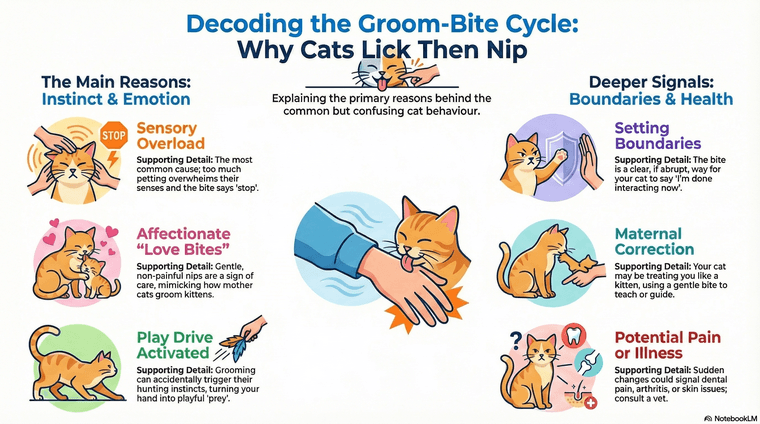
Now let’s explore the various explanations for this confusing behavior pattern. Understanding “why does my cat groom me then bite” helps you respond appropriately.
Overstimulation and Sensory Overload
This is probably the most common reason for the groom-bite cycle. Think of your cat’s nervous system like a cup filling with water. Pleasant sensations, like grooming, being petted, or engaging in affection, add water to the cup. At first, it feels great. But cats have relatively low thresholds for stimulation, and that cup fills up faster than you might expect.
When the cup overflows, your cat reaches sensory overload. They’re overwhelmed by the intensity of sensation and need it to stop. The bite is their way of hitting the emergency brake. Signs of approaching overstimulation include:
- Tail starting to twitch or lash
- Skin rippling along their back
- Ears rotating backward
- Body tensing up
- Pupils dilating
- The rhythm of licking becoming faster or more intense
The grooming itself can be the trigger, the repetitive sensation of their own tongue on your skin, combined with your scent and taste, builds up sensory input until they can’t handle more. The bite says, “That’s enough stimulation. I need a break.”
“Love Bites” as Affection Expression
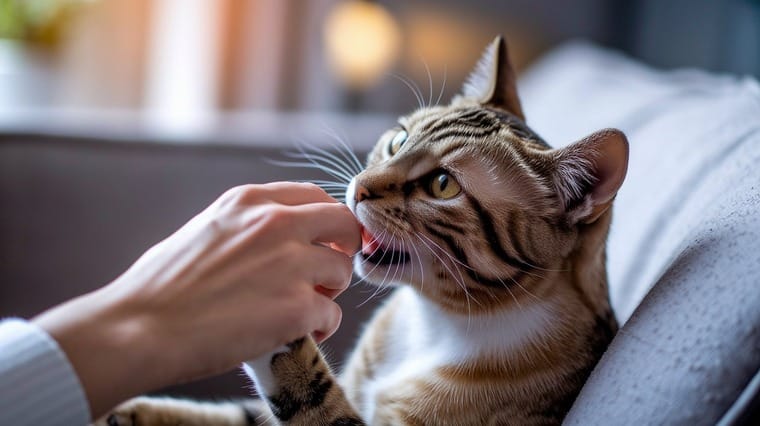
Not all biting is about overstimulation. Sometimes, the bite is actually part of the affection display itself, what we call “love bites.” These are different from aggressive bites:
Love bite characteristics:
- Gentle pressure that doesn’t hurt or break skin
- Almost like a nibble or soft grab with teeth
- Accompanied by continued purring and relaxed body language
- Your cat doesn’t pull away or show defensive postures
- Often followed by more licking
Cats learn this behavior from their mothers. Mother cats gently bite their kittens as part of grooming, care, and sometimes discipline. It’s a communication tool that says, “I love you, but calm down” or simply “You’re mine and I adore you.” Adult cats often recreate this behavior with their humans, especially if they were well-socialized as kittens.
Some cats genuinely don’t realize these nibbles hurt us. Our skin is much more sensitive than their fur-covered bodies, and what feels like a gentle love nip to them might be surprisingly painful to us.
Grooming Leading to Play Mode
Grooming can accidentally activate your cat’s prey drive, especially in younger, more playful cats. Here’s how: as your cat licks your hand or arm, they feel the slight movement of your skin, see the fine hairs moving, and suddenly their hunting instinct kicks in.
Your hand transforms from “thing I’m grooming” to “thing that might be prey.” The switch flips from affection mode to play mode, and before they can stop themselves, they’ve pounced and bitten. You’ll often notice this transition includes:
- Sudden pupil dilation
- Ears perking forward in hunting position
- Body tensing in preparation to pounce
- A brief pause in licking before the bite
- Sometimes grabbing with front paws
This is particularly common with cats who have high energy levels and strong prey drives. The grooming inadvertently triggers their hunt-catch-kill sequence, and you become the “prey.”
Maternal Instinct Activation
Female cats, especially those who have had kittens or have strong maternal instincts, might groom-then-bite as a form of maternal care. Mother cats use gentle bites to:
- Correct kitten behavior
- Move kittens to safer locations
- Teach boundaries and limits
- Show affection mixed with discipline
When your cat grooms you then gives you a little bite, they might be treating you like a kitten who needs some correction. It’s their way of saying, “I love you, but you need to settle down” or “Let me care for you, but also let me teach you proper behavior.”
This behavior is more common in cats who are particularly nurturing or who imprinted strongly on their humans during their own kittenhood.
Communication of Boundaries
Sometimes your cat grooms you then bites simply to communicate, “Okay, that’s enough interaction for now.” Cats are wonderfully independent creatures who value their autonomy. They might initiate grooming because they want connection, but after a certain amount of time, they’re done and want space.
The bite is their way of saying:
- “I’ve given you enough attention”
- “I’m controlling when this interaction ends”
- “I need some alone time now”
- “Stop petting me while I’m grooming you”
This is actually healthy boundary-setting. Your cat is communicating their limits clearly (from their perspective). The challenge is that we humans don’t always recognize or respect these signals until the bite happens.
Mixed Emotions and Conflicting Drives
Cats can experience conflicting emotions simultaneously, they want affection but also value independence. They love you but can be overwhelmed by their feelings. This internal conflict might manifest as the groom-bite pattern.
Think of it like when you love someone so much you want to squeeze them tight, that “cute aggression” humans experience. Cats might have similar overwhelming feelings that result in mixing gentle grooming with biting. It’s confusing to them too!
Individual personality plays a huge role here. Some cats are more comfortable with sustained affection, while others have short tolerance windows even when they genuinely love their humans.
Medical or Pain-Related Causes
Sometimes the grooming-biting cycle indicates physical discomfort:
- Dental problems: Painful teeth or gums might make the act of licking uncomfortable, leading to biting
- Skin sensitivity: Allergies or dermatitis can make even gentle touch painful
- Arthritis: Pain in joints might make certain positions during grooming uncomfortable
- Neurological issues: Rarely, conditions like feline hyperesthesia can cause sudden behavior changes
If your cat’s grooming-biting behavior is new, has increased dramatically, or seems accompanied by other symptoms (appetite changes, lethargy, vocalization), schedule a veterinary exam to rule out medical causes.
Reading the Body Language: Love Bite vs. Aggression
Understanding the difference between affectionate behavior and genuine aggression is crucial for understanding why your cat grooms you then bites.
Signs of Affectionate “Love Bites”
When the biting is part of normal social behavior and affection:
✓ Gentle bite pressure – Doesn’t break skin, more like a firm pinch
✓ Relaxed body – No tension, muscles soft
✓ Purring continues – Often purring before, during, and after
✓ Ears forward or neutral – Not pinned back
✓ Eyes half-closed or soft – Relaxed, trusting expression
✓ Tail calm – Gently moving or still, not lashing
✓ May lick again after biting – Grooming continues
✓ No vocalization – No hissing, growling, or spitting
Signs of Aggressive or Defensive Biting
When biting indicates actual aggression or fear:
✗ Hard bites – Painful, potentially breaking skin
✗ Tense, rigid body – Coiled, ready to fight or flee
✗ Flattened ears – Pinned back against head
✗ Dilated pupils – Eyes wide and dark
✗ Puffed tail – Bottlebrush appearance
✗ Hissing or growling – Vocal warnings
✗ Claws extended – Often scratching accompanies biting
✗ Body pulled away – Defensive or fearful posture
✗ No purring – Ceased all content sounds
Overstimulation Warning Signs
The trickiest category is overstimulation, which sits between affection and aggression:
⚠ Tail twitching – Starts slow, increases
⚠ Skin rippling – Visible waves along back
⚠ Ears rotating – Moving from forward to sideways/back
⚠ Pupils dilating – Eyes getting wider
⚠ Licking faster – Rhythm speeds up
⚠ Watching your hand – Intense focus on the area being touched
⚠ Body tensing – Gradual stiffening
Learning to read these signs lets you end interaction before the bite happens.
How to Respond When Your Cat Grooms Then Bites
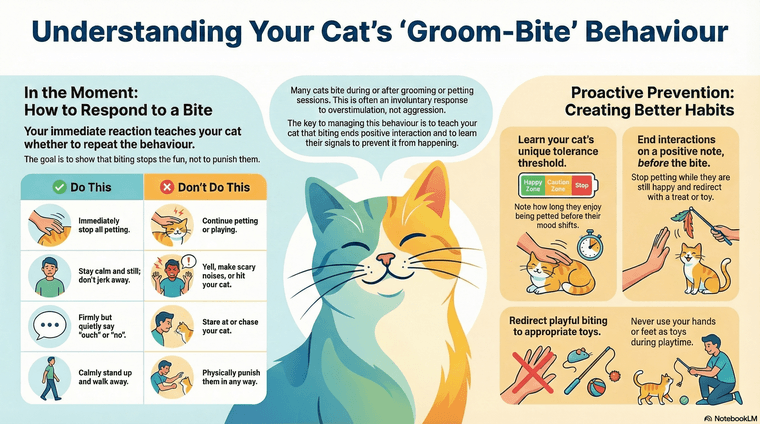
Your response to the groom-bite cycle significantly affects whether it continues or diminishes.
Immediate Response Strategies
When the bite happens:
Do this:
- Stop all interaction immediately – No more petting, no more engagement
- Stay calm and still – Don’t jerk your hand away suddenly (triggers prey drive)
- Say “ouch” or “no” firmly but quietly – Not yelling, just clear communication
- Stand up or walk away – Calmly end the interaction
- Give your cat space – Leave them alone for a few minutes
Don’t do this:
- Never hit or physically punish your cat
- Don’t yell or make scary noises
- Don’t continue petting or playing after the bite
- Don’t stare at your cat confrontationally
- Don’t chase or corner your cat
The goal is teaching your cat that biting ends the fun interaction, not punishing them for what is often normal behavior.
Reading Early Warning Signs
The best approach is preventing the bite entirely by recognizing your cat’s threshold:
Track patterns:
- How long does your cat typically groom before biting? (30 seconds? 2 minutes?)
- What body part are they grooming when it happens?
- Time of day patterns?
- What were they doing before approaching you?
End interaction proactively: Once you know your cat usually bites after 60 seconds of grooming, stop at 45 seconds. Stand up, offer a treat, redirect to a toy, anything that ends the interaction on a positive note before overstimulation occurs.
Teaching Gentleness Over Time
You can gradually reshape this behavior:
Positive reinforcement approach:
- During grooming, reward your cat with treats or gentle praise when they’re being gentle
- The moment they show any warning sign (tail twitch, ears back), calmly end interaction
- Keep sessions short initially
- Gradually extend duration as your cat learns better self-control
- Be consistent, everyone in household must respond identically
Redirect to appropriate outlets:
- When your cat seems playful and bitey, redirect to interactive toys
- Wand toys, feather chasers, and laser pointers (ending with catchable toy) satisfy play drive
- Never use your hands as toys
- Provide solo play options (balls, mice, crinkle toys)
This training takes weeks to months. Patience and consistency are essential.
Creating Better Interaction Patterns
Structure your bonding time for success:
Shorter, positive sessions:
- 3-5 short interactions throughout the day
- Stop before biting occurs
- End on positive notes
- Your cat will associate you with pleasant experiences
Your terms, not theirs:
- You initiate and end interactions
- Don’t always respond when cat demands attention
- Teach that calm behavior gets attention, not biting
Alternative bonding activities:
- Play sessions with toys
- Training tricks (cats can learn!)
- Parallel play (being near each other)
- Grooming them (if they enjoy brushing)
Prevention and Management Strategies
Long-term management involves understanding and respecting your cat’s individual needs.
Understanding Your Cat’s Threshold
Every cat has unique tolerance levels. Factors affecting threshold include:
- Personality: Some cats are naturally more tolerant
- Socialization: Well-socialized kittens often handle interaction better
- Current mood: Tired, hungry, or stressed cats have lower thresholds
- Environment: Calm environment = higher tolerance
- Your behavior: Gentle, predictable humans get longer interaction times
Keep a journal for a week noting when grooming-biting occurs. Patterns emerge that help you anticipate and prevent.
Providing Appropriate Outlets
Cats need proper channels for their energy and instincts:
Physical exercise:
- Interactive play sessions (10-15 minutes, 2-3 times daily)
- Climbing structures and cat trees
- Window perches for mental stimulation
- Chase toys and puzzle feeders
Mental stimulation:
- Food puzzles
- Hide-and-seek with treats
- Rotating toys to maintain interest
- Cat TV or videos
A well-exercised, mentally satisfied cat is less likely to overstimulate during affection time.
When to Involve Professionals
Consult experts if:
- Biting is getting harder or more frequent
- You see signs of real aggression (not just overstimulation)
- Behavior changed suddenly
- Other symptoms accompany biting
- You’re afraid of your cat
- Quality of life is affected for you or your cat
A veterinarian can rule out medical issues. A certified cat behaviorist can develop customized behavior modification plans.
Special Situations and Considerations
Different circumstances require adapted approaches.
Kittens Learning Boundaries
Kittens haven’t learned bite inhibition yet. When kittens groom-bite:
- This is normal developmental behavior
- They’re practicing social skills
- Mother and siblings usually teach gentle play
- Single kittens need extra training from humans
- Consistency is crucial during this learning phase
- Most kittens improve significantly by 9-12 months
Teaching kittens: Make a high-pitched “ow!” sound when bitten (mimics kitten distress sounds), stop playing immediately, walk away for 30 seconds, return and resume gentle play. Repeat consistently.
Children and Cat Interactions
Kids often struggle with recognizing cat body language:
- Supervise all interactions between young children and cats
- Teach kids warning signs before biting occurs
- Create rules: If cat bites, playtime ends (child walks away)
- Model appropriate behavior – kids learn by watching you
- Provide escape routes for cats to leave when overwhelmed
Some cats simply aren’t good matches for young children. That’s okay, everyone’s safety and wellbeing matters most.
Cats with Traumatic Backgrounds
Rescue cats or those with unknown histories might have different triggers:
- Build trust slowly, weeks or months
- Let cat initiate most interactions
- Shorter sessions with lower expectations
- Celebrate small progress
- Consider working with behaviorist
- Some cats never become lap cats, and that’s fine
Patience and understanding are essential. These cats often make incredible companions once they feel secure.
Living Harmoniously with a Grooming-Biting Cat
Accepting and working with your cat’s behavior creates a better relationship for everyone.
Finding the Balance
Most grooming-biting cats aren’t trying to be mean, they’re communicating in the only way they know. Your job is:
- Learning their unique language
- Respecting their boundaries
- Providing appropriate outlets
- Celebrating the affection even when it comes with teeth
- Adjusting expectations to reality
The cat who grooms-then-bites is often deeply affectionate. They’re just not great at regulating their feelings. That’s actually kind of endearing when you think about it!
Celebrating the Bond
Even if interactions must be shorter or more carefully managed, grooming behavior indicates strong attachment. Your cat:
- Trusts you completely
- Considers you family
- Wants to care for you
- Values your relationship
That’s worth a few love bites, isn’t it? (Just maybe keep a first aid kit handy.)
Conclusion
Understanding “why does my cat groom me then bite” comes down to recognizing that this behavior usually stems from overstimulation, affectionate communication, or play drive activation rather than actual aggression. Your cat’s rough tongue combined with their intense focus on grooming you can overwhelm their nervous system, triggering the bite as a way to end the sensory overload. Learning to read the warning signs, tail twitching, ears rotating back, pupils dilating, allows you to end interactions before the bite occurs, while respecting that gentle love bites are often just your cat’s clumsy way of saying “I adore you so much I can’t help myself.”
The key to managing this behavior is patience, observation, and consistent responses. Keep grooming sessions short and end them on your terms before overstimulation occurs, redirect play-related biting to appropriate toys, and never punish what is usually normal feline communication. With time and understanding, you and your cat can find a rhythm that works for both of you, one where you appreciate their grooming as the profound sign of affection it truly is, and they learn to express that affection without quite so many teeth. The bond you share is worth the occasional love bite!
Also Read - Cat Kneading with Claws Out: Why It Hurts and How to Stop It
Frequently Asked Questions
Is it normal for my cat to lick me then bite me immediately after?
Yes, this is completely normal cat behavior. The groom-bite cycle typically results from overstimulation (they’ve given/received too much sensation and need it to stop), love bites (gentle nibbles that are meant affectionately), or play drive activation (your movement triggers hunting instincts). As long as the bites are gentle, your cat’s body language is relaxed, and they’re not showing aggression signs (flattened ears, hissing, hard bites), this is just your cat’s way of communicating. Learn your cat’s threshold, how long they can groom before needing to bite, and end interactions just before that point.
How can I tell if my cat’s bite is playful or aggressive?
Playful or affectionate bites are gentle (don’t break skin), accompanied by relaxed body language (ears forward, soft eyes, calm tail), and often followed by more grooming or purring. Your cat stays engaged and close. Aggressive bites are hard and painful, accompanied by tense body (arched back, puffed tail, flattened ears), defensive vocalizations (hissing, growling), dilated pupils, and your cat typically tries to escape or create distance afterward. The context matters too, if your cat approached you voluntarily and initiated the grooming, it’s almost certainly not aggression even if the bite feels sharp.
Should I let my cat groom me or discourage this behavior?
This depends on your preference and your cat’s behavior. Grooming is a sign of deep affection and bonding, so if the biting is manageable (gentle love nips) or predictable (you can end sessions before it happens), letting your cat groom you strengthens your relationship. However, if the biting is painful, frequent, or stressful, you can gently discourage it by standing up and walking away when grooming starts, redirecting your cat to toys, or simply not providing access to your hands/arms. Never punish, just calmly make grooming less available or rewarding.
Why does my cat only groom and bite me, not other family members?
You’re the chosen one! Cats typically show this intense grooming behavior with their primary attachment figure, the person they bond with most strongly, usually whoever feeds them, plays with them most, or spends the most time with them. It’s actually a compliment showing you’re their favorite. Other family members might receive different affection displays. Also, your cat may have learned different boundaries with different people, if others consistently don’t allow grooming, your cat respects that, while they’ve learned you’re more tolerant of the behavior.
Can I train my cat to stop biting after grooming?
Yes, but it requires consistent effort over weeks to months. The key is ending interactions before the bite occurs, once you know your cat’s typical threshold (say, 60 seconds of grooming), stop at 45 seconds every time. Stand up, walk away calmly, or redirect to a toy. When they groom without biting, reward with treats or gentle praise. If biting happens, immediately end interaction without drama, no punishment, just stop engaging for 5-10 minutes. Everyone in your household must respond identically for training to work. Some cats will always give occasional love nips, but you can significantly reduce frequency and intensity with patient, consistent boundary-setting.